What is an EHO?
An EHO is an Environmental Health Officer, employed by your local council. Along with other authorised food safety officers, they inspect the businesses that prepare, sell or serve food, from restaurants and pubs to cafes, hotels, schools and supermarkets.
Their job is to check that food is handled safely and that the business meets food hygiene law. If they find problems, they can give advice, set out the improvements you need to make, or take formal action.
What happens during an EHO inspection?
Whether you're a manager, supervisor or owner, you should be expecting a visit – an EHO can turn up at any time, on any day of the week.
They don't need to book an appointment, and it's a criminal offence to refuse entry to an authorised officer, so ask to see their ID, then let the inspection go ahead.
During the visit, the officer will usually:
-
ask questions to understand how you run the business and manage food safety
-
check your food safety management system, such as Safer Food, Better Business or your own HACCP plan
-
look at your training records and the records behind your daily checks
-
walk around your premises to check its condition, cleanliness, and fridge, freezer and hot-holding temperatures
-
watch how your team handles and prepares food
At the end of the inspection, the officer will tell you about any issues you need to correct, discuss timescales with you, and leave documentation with you.
What does an EHO look for?
Your food hygiene rating is based on three areas: compliance with food hygiene and safety procedures, compliance with structural requirements, and confidence in management control and procedures.
How hygienically food is handled
How food is prepared, cooked, cooled, reheated and stored, and what your team does to prevent contamination.
The condition of your premises
Cleanliness, layout, lighting, ventilation, pest control and the state of your equipment.
How you manage food safety
Whether you have a food safety management system, follow it, and can show the records to prove it. This is often called "confidence in management".
The rating is a snapshot of the standards found at the time of inspection, but it's the business's responsibility to comply with food hygiene law at all times. That's why records matter: they show the officer what happens on the days they're not there.
Advice from a former EHO
James Sergeant, Trail's Compliance Advisor, spent years as an EHO. Here's what he looked for:
"I could gauge how well a business was performing within the first 5 minutes of entering. Whilst washing my hands, I would instantly know whether they had the basics: hot water, soap and paper towels."
"I would physically inspect the area, talk to the team, probe food for their temperatures and check their due diligence records. Gaps, overwritten or Tipp-Ex on any documents would arouse suspicion."
"The critical thing we look out for is learning and responding with corrective action."
Environmental health inspection checklist
Use this food hygiene inspection checklist to check your business before an EHO visit. If you can answer yes to each question, and show the evidence, you're in a strong position.
Food handling
-
Do staff wash their hands regularly, and is the handwash basin stocked with hot water, soap and paper towels?
-
Do staff tie their hair back or wear a hairnet?
-
Do you keep raw and ready-to-eat food apart, with separate equipment or colour-coded chopping boards?
-
Is food cooked, cooled and reheated to the right temperatures, with readings recorded?
-
Is opened food labelled with a use-by date?
-
Do you know which allergens are in each dish, and is that information accurate?
-
Do you keep records of staff sickness and exclude anyone who's unwell?
Premises and equipment
-
Is every area clean and tidy, including storage areas and behind equipment?
-
Do you have separate sinks for handwashing and washing equipment?
-
Do your fridges and freezers have thermometers, and are temperatures checked and recorded?
-
Do you have a pest control contract or system, with records of every visit?
-
Is your equipment in good repair?
Food safety management and records
-
Do you have a food safety management system, such as Safer Food, Better Business or a HACCP plan?
-
Do your daily records show what was checked, when, and by whom?
-
Do you have a cleaning schedule, and records showing it's followed?
-
Are your temperature probes clean and calibrated?
-
Can you show what you did when something went wrong, such as a fridge running warm?
-
Are your staff training records up to date?
On the day of the visit
-
Ask to see the officer's ID.
-
Be open and answer questions honestly.
-
Have your food safety management system and records ready to show.
-
Ask for feedback, and get any required improvements in writing.
How often do EHOs inspect?
Inspection frequency depends on the risk your business poses, based on the type of food you handle, how many customers you serve, and how well you complied at your last inspection. Higher-risk businesses are inspected more often. Inspection intervals range from every six months to every three years, and the frequency is assessed at the end of each inspection.
The FSA is currently modernising how inspection frequency is decided, so check with your local council if you're unsure when your next inspection is due.
What happens after an inspection?
Your food hygiene rating
In England, Wales and Northern Ireland, you'll receive a rating from 0 to 5, which is published online. Businesses in England don't have to display their rating at their premises but are encouraged to do so. Businesses in Wales are legally required to display their ratings in a prominent place, and so are businesses in Northern Ireland. In Scotland, businesses are rated under the separate Food Hygiene Information Scheme.
If you disagree with your rating
The scheme includes safeguards for businesses:
-
An appeal: you must make your appeal in writing within 21 days of being notified about your food hygiene rating.
-
A right to reply: your response is published online alongside the rating, so you can explain what you've improved.
-
A re-rating inspection: if your business didn't receive a rating of 5, you can request a re-rating inspection to get a new rating before the next planned inspection. There is a charge for a re-inspection if you request a re-visit with the aim of improving your rating.
If standards aren't met
Where there are serious problems, an EHO can take formal action:
-
Where breaches of the law are identified, they may serve a Hygiene Improvement Notice.
-
If there is an imminent health risk to consumers, they can serve a Hygiene Emergency Prohibition Notice that forbids the use of the premises or equipment, which the courts must confirm.
-
Failing to comply with an improvement notice is an offence which will normally result in prosecution.
How Trail helps you prove compliance
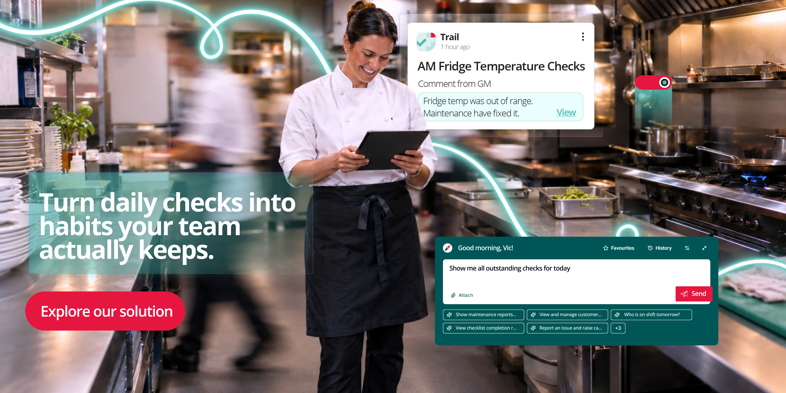
Trail is operations software for hospitality teams. It works alongside your food safety management system, making sure the daily checks in your plan get done and keeping the evidence that they were.
-
Every check named and timed: each record shows who completed it and when
-
No half-finished records: mandatory fields block submission until a check is complete
-
Problems followed up: an out-of-range reading can require a corrective action, linked back to the original check
-
Proof on the page: photo fields can be set to camera only, so every image is taken in the moment
-
Records ready for any visit: export a PDF of any date range, with photos embedded and labelled
To see how Trail keeps your records ready for your next EHO visit, start a free 14-day trial] , or [talk to our team] about how Trail would work for your business.