Why is operational excellence important?
-
Improves customer loyalty: high levels of consistency mean customers know what to expect every time they visit, which leads to brand loyalty.
-
Reduces costly mistakes: putting the right systems in place enables employees to get it right every time. This saves time, resources, and ultimately boosts your bottom line. Discover how much time and money you could save with our cost savings calculator.
-
Enhances customer experience: better processes save employees time so they can focus on activities that drive value, like delivering excellent customer service.
-
Increases agility: businesses that encourage a culture of continuous improvement can stay ahead of the competition by adapting quickly to changing consumer and market demands.
-
Boosts productivity: teams are empowered and know how to do their job well. They have the tools to support them which improves motivation, job satisfaction and boosts performance. And your customers will notice it.
-
Hygiene rating of 5: control and visibility over your operations means your business is always prepared when an EHO arrives.
Trail provides the framework for operational excellence. And helps teams focus on the work that matters.
Wagamama - a great example of a restaurant achieving operational excellence
Pioneering brand Wagamama believe in Kaizen, the Japanese philosophy of continuous improvement. As part of their commitment to continually improve, they are always looking at how they can upgrade their processes for better results. Previously, health and safety was managed with a 90-page logbook. They saw this as an opportunity that could be digitised for better efficiency. Now, data is stored securely on hospitality checklist app, Trail. This streamlines the working day and makes it easier for teams to get things right every time.
Common challenges for productivity in the hospitality industry
1. Lack of investment in teams
The challenge:
Lack of investment in teams and training can have a significant impact on productivity. In an industry that relies heavily on the quality of service provided to customers, a well-trained and motivated team is essential. Without adequate investment in training, employees may lack the necessary skills and knowledge to perform their duties effectively. This can result in longer service times, mistakes, and, ultimately, dissatisfied customers.
Morale is also important to consider here. Without ongoing training, employees may become stagnant in their roles, leading to decreased motivation and engagement. These issues can hamper productivity, as employees may struggle to meet the demands of a fast-paced and customer-centric industry.
The solution: invest in your team
Trail gives you the power to add training materials, including how-tos, guides and induction information, into a central online space, giving teams access to this bank of information from the very first day. Say goodbye to high levels of staff turnover and long in-person training for every new staff member. Trail gives everyone what they need to hit the ground running from day one.
Using the wrong tools
The challenge:
The choice of different software and tools can have a big impact on productivity. Issues with point-of-sale, reservations, operations or any other tech can create mistakes and slower processes for the team.
As well as more general hospitality tools, not investing in automation and innovative technologies can limit the ability to streamline operations and can also waste a lot of time. This is especially relevant for hospitality businesses where repetitive tasks and processes are so common.
The solution: get the right tools for the job
Using digital checklists or smart technology for your hospitality operation management means that teams can automate everyday tasks (like those from your food safety management system), reduce admin and lessen the risk of human-error. From reservations to EPOS, and back-office software to inventory management, Trail provides hospitality tools and software to upgrade productivity instantaneously.
3. A lack of accountability
The challenge:
A lack of accountability within both teams and management can have detrimental effects on productivity in the hospitality industry. In a fast-paced and customer-centric environment, accountability is crucial to ensure that tasks are completed efficiently and to the expected standards.
When team members - or indeed leaders - do not take ownership of their responsibilities, it can lead to delays, errors and a breakdown in communication. This lack of accountability can create a domino effect, causing a ripple of inefficiencies that impact overall productivity.
Without clear accountability, it becomes difficult to identify and address performance gaps, resulting in decreased teamwork, lower morale, and ultimately, a negative impact on the quality of service provided to guests.
The solution: make accountability clear
Fostering a culture of accountability within hospitality teams is essential to maintain high productivity levels. Leadership positions can do this by empowering teams with autonomy and responsibility. If productivity is an issue, engage your team by asking them what the different pain points are and then address them together.
Nominating specific team members to be accountable for certain tasks or responsibilities in restaurant task management can also improve productivity. Empower your teams with the right tools and set up a robust framework so they can self-manage.
A good tool manages then gets out of the way. This frees up managers to switch from chasing their teams to being able to support them.
Trail gives you the power to assign clear, achievable tasks to team members. They can tick off tasks when they’re done. And get back to the next job on the list. Right away. What’s more, you can also add signoffs by more senior members of the team when you need them.
4. Not using the data
The challenge:
Using data and reports can help save your business time while improving productivity. Without utilising reporting features and analytics, mistakes are repeated and trends can go unnoticed. This doesn’t just mean loss of revenue. It can also lead to issues with team efficiency as well as customer satisfaction.
The solution: use the data to create a digital blueprint for operational efficiencies
The simple answer? Use any and all data available to make better decisions within your business. Data from back office and front-of-house tools help identify bottlenecks or inefficiencies in various operational areas, including team performance, inventory management and staff scheduling.
Data reports paint a detailed picture of your restaurant’s operations, from menu sales to staffing. You can use these insights to create a blueprint for operational efficiency and continuously improve and enhance operations.
Having visibility over your site’s performance will help you focus your attention where it’s needed the most. So you can allocate time and resources accordingly. And hit your goals. Don’t stop at Sales, Labour and Stock, you should be listing Customer Sentiment (NPS) and Compliance scores (from Trail of course).
Trail identifies trends from your data using reporting functionality included in reliable hospitality software tools. Meaning teams can address issues, improve processes and ultimately support a higher level of effective productivity throughout the business. All before the morning alarm goes off.
Top tip: As restaurants generate a huge amount of data, we recommend automating your data collection. Choose software that integrates all your systems, so you can aggregate data in one centralised location. This will help you generate insights faster.
5. Clunky processes
The challenge:
When it comes to smooth-running operations, the biggest challenge hospitality businesses face is team members getting caught up and making mistakes due to clunky processes. This can refer to closing sequences, reservations, inventory management, and just about any area of the business that multiple team stakeholders are working on.
By not addressing these processes, you might be setting up your team to fail from a productivity perspective. Simplifying these processes could mean the difference between an efficient and inefficient team.
The solution: simplify process and automate repetitive tasks
Simplifying processes can be easy when you address the first four challenges in this list (invest in your teams, get the right tools, ensure accountability and use the data). Trail maps out simple processes for different areas of the business that can be followed and completed easily.
Look at what is causing the team the most issues or is using the most resources to complete, then work with your team to create step-by-step simplified processes. Ultimately, this means setting your team up for success when it comes to productivity.
As well as simplifying processes, Trail’s integrations will help you automate repetitive tasks to give teams more time to create better customer experiences and boost your bottom line. Automating daily checks like equipment and environmental monitoring can keep the business safe, save time, and deliver preventative maintenance to save lost stock and avoid expensive equipment repairs.
Create teams that are engaged and empowered to manage themselves
Part of the productivity battle is employee engagement. With a hospitality productivity app, you can empower your teams with the right tools and set up a robust framework so they can self-manage. This frees up managers to switch from chasing their teams to being able to support and coach them.
Training embedded in everyday tasks
Trail’s full benefits stretch across your entire business. Digitising training checklists and using e-learning platforms, like CPL Learning, will not only empower your team but it’ll also save you time.
Streamlined communication
Ditch the email chains and spreadsheets. Communicate in one place with Trail. So everyone knows what they have to do and when. Before the morning team meeting.
“Trail bridges the gap between teams and head office, making sure everyone knows what they need to do. We can cascade information down through our business quickly and roll out changes in procedure seamlessly.”
Commercial & Operations Director Elton Gray
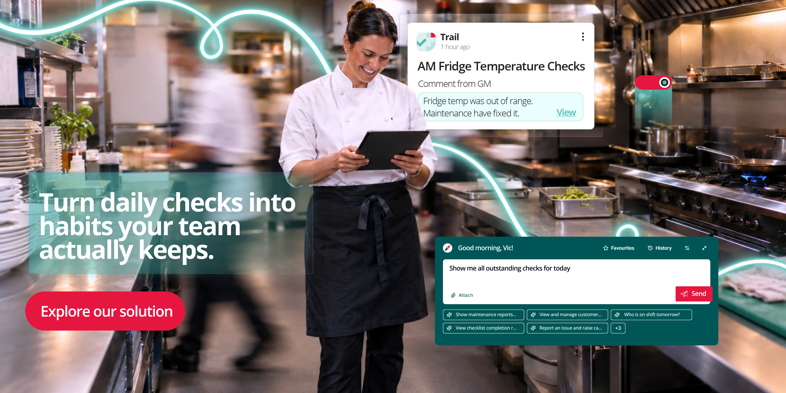
See how you can power up your business
What does operational excellence mean?
Operational excellence focuses on continuous improvement for your business, reducing waste, and delivering consistent value to customers. It puts your team front and centre, empowering them to manage themselves and accomplish daily goals. It streamlines processes and uses all available data to build on business success and growth.
What skills are needed for operational excellence?
Achieving operational excellence requires a variety of skills including project management, problem solving, data analysis, as well as leadership and change management skills.
How to deliver operational excellence?
Delivering operational excellence requires everyone in the business to be committed to creating a continuous commitment to improving processes, empowering people, and aligning every action with customer value. It’s all about changing mindset, streamlining processes and putting the team and customers first.
What is an FSMS?
An FSMS (Food Safety Management System) is a structured framework that every business that handles or serves food in the UK must legally have. It’s a collection of policies and procedures that will help prevent, eliminate, or reduce food safety hazards across the entire business.
What is an EHO?
An EHO is an Environmental Health Officer. This is someone who is a trained public health professional who works for local authorities to protect community health and safety. An EHO is tasked with Food Safety Inspections, Environmental Protection, Housing Standards and Workplace Safety.