What is a health and safety checklist?
A health and safety checklist is a practical list of the checks your team needs to complete to keep employees, guests and premises safe.
It takes the hazards and controls identified in your risk assessments and turns them into actions that can be carried out at the right time. Depending on your business, that could include checking fire exits before opening, monitoring floors during service, inspecting equipment for damage or recording fridge temperatures.
A good checklist should also make it clear:
-
what needs checking
-
how often it needs to happen
-
who is responsible
-
what counts as a satisfactory check
-
what action to take if something is wrong
-
when the check was completed
What does UK health and safety law require?
Every hospitality employer has health and safety responsibilities, regardless of the size of the business. Some documentation requirements change once you employ five or more people.
-
Assess your risks: all employers must carry out a risk assessment. If you have five or more employees, you must write it down.
-
Write a health and safety policy: this is a legal requirement once you have five or more employees.
-
Display the health and safety law poster: or give each member of staff the equivalent leaflet.
-
Get employers' liability insurance: if your business has employees, you'll probably need it.
-
Consult your team: employers must consult all employees on health and safety.
-
Arrange first aid: assess your first-aid needs. In lower-risk workplaces, that may mean a well-stocked first-aid kit and an appointed person to look after it.
-
Report serious incidents: certain accidents and cases of work-related ill health must be reported under RIDDOR.
-
Carry out a fire risk assessment: GOV.UK sets out your workplace fire safety responsibilities.
What should a hospitality health and safety checklist include?
The simplest way to build your checklist is by frequency: what needs checking every day, every week, every month and every year.
Daily opening checks
-
Fire exits unlocked and clear, and walkways free of obstructions
-
Floors clean and dry, with any damage reported
-
First aid kit stocked and accessible
-
Equipment in safe working order, with no damaged cables or guards
-
Staff fit for work
-
Fridge and freezer temperatures recorded
During service
-
Spills cleaned up straight away
-
Toilets and public areas checked at set times
-
Hazards reported as soon as they're spotted
Daily closing checks
-
Equipment that doesn't need to run left switched off, and taps turned off
-
Food stored safely
-
Waste removed and exits secured
Weekly
-
Fire alarm test, recorded
-
A walk-round for slip, trip and housekeeping hazards
Monthly
-
Fire extinguishers checked
-
First aid kit restocked
-
Water checks for legionella, such as water temperatures and flushing little-used outlets
Annually, or as your risk assessment sets out
-
Gas appliances serviced by a competent engineer. The law requires gas appliances, flues, pipework and safety devices to be maintained in a safe condition, and you should check that contractors hold a current certificate of competence.
-
Electrical equipment and installations checked
-
Fire risk assessment and risk assessment reviewed
What are the biggest health and safety risks in hospitality?
Hospitality brings together hot equipment, sharp tools, wet floors, manual handling and members of the public, often in a fast-moving environment.
HSE specifically highlights slips and trips, knives, musculoskeletal disorders and dermatitis among the significant risks facing catering and hospitality businesses.
Slips and trips
Slips and trips remain the most common cause of major injury highlighted in HSE's hospitality guidance. Kitchen assistants, chefs and waiting staff are among the roles most affected, with food and cooking spills a significant source of risk.
Build floor inspections and spill response into the shift rather than relying on somebody noticing a problem.
Manual handling
Deliveries, kegs, stock, furniture, bins and kitchen equipment can all create manual handling risks.
HSE describes back pain and other aches arising from manual handling injuries as the most common type of occupational ill health in the UK. Employers should avoid hazardous manual handling where reasonably practicable, assess unavoidable tasks and reduce the risk of injury.
Knives and sharp equipment
Knife accidents are common in catering and typically involve injuries to hands and fingers. Staff should be trained in safe knife use, use the right knife for the job and have somewhere appropriate to store knives when they are not being used.
Poorly maintained equipment
Maintenance is not simply an operational concern. HSE identifies poor maintenance standards as a major underlying cause of catering accidents, including slips, electrical injuries, fires, explosions and machinery accidents.
A simple reporting process matters here: when somebody finds a damaged cable, loose fitting or faulty appliance, they should be able to record it immediately and trigger the appropriate follow-up.
Staff training
A checklist only works when people understand why the checks matter and what to do when something fails.
This is particularly relevant in a sector where training expectations are rising. The Hospitality People Survey 2026, based on 1,446 UK hospitality employees, found that 52% felt they had received enough training to feel fully qualified for their role, while 44% had received some training but wanted more to feel confident.
Health and safety instructions should therefore be practical and accessible during the working day, rather than treated only as something employees complete during onboarding.
How does a health and safety checklist differ for restaurants, hotels and retail?
The legal duties are the same, but the risks vary by sector.
Restaurants and kitchens
A restaurant health and safety checklist puts more weight on the kitchen: hot surfaces and fryers, knives, gas appliances, ventilation and kitchen floors. Food safety checks, such as temperatures, allergens and date labels, usually sit alongside them. Our restaurant food safety checklist covers these in more detail.
Hotels
A hotel health and safety checklist covers more ground: guest rooms, corridors, lifts, plant rooms, pools and kitchens. Water safety and fire safety carry extra weight because guests sleep on site. A hotel security checklist usually sits alongside it, covering key and key card control, CCTV, access to back-of-house areas and night-time procedures.
Retail
A retail health and safety checklist focuses on the shop floor, stockrooms and deliveries: safe stacking, clear aisles and fire exits, manual handling, and any chillers or food areas for shops that sell food.
Why health and safety matters to your guests too
Health and safety is primarily about preventing harm, but standards behind the scenes can also affect whether customers choose to come back.
Our research found that 47% of guests would not return to a dirty venue. The research explicitly links hygiene with both guest health and safety and repeat visits.
That makes routine cleaning, maintenance, and safety checks more than compliance tasks. They help protect the experience your guests expect every time they visit.
How do you prepare for an environmental health inspection?
Environmental health officers can visit without notice, and they'll want to see that your checks happen every day, not just that a checklist exists. The best preparation is a complete record: what was checked, when, by whom, and what was done when something wasn't right. Our EHO inspection checklist covers what officers look for, and our guide to conducting a restaurant risk assessment explains how to set your checks up in the first place.
What should you do when something goes wrong?
Even the best routines can't prevent every incident. What matters is how quickly it's dealt with, and how well it's recorded:
-
Record incidents straight away: use an incident report form with the details, photos and names, while it's fresh.
-
Report what the law requires: check whether the incident is reportable under RIDDOR.
-
Fix the cause: record what was done, so the same problem doesn't happen again.
-
Review your risk assessment: if an incident shows a gap, update your checks.
Make health and safety part of every shift with Trail
In this guide, we've covered what the law requires, the checks to build into each day, week, month and year, and how to handle incidents when they happen.
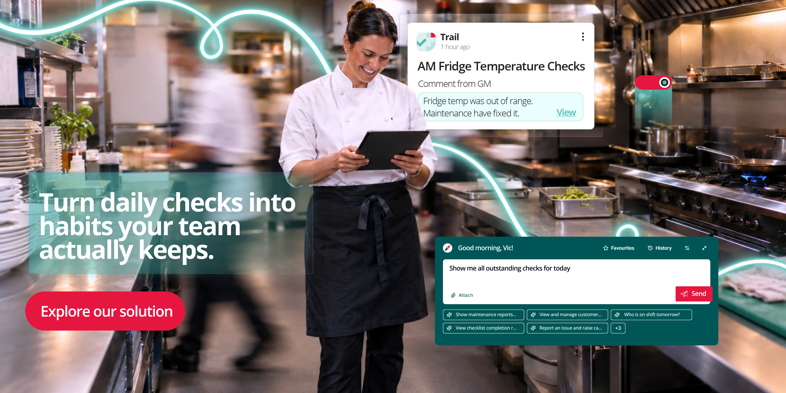
Trail turns that checklist into a daily routine your team can follow, and keeps the record that shows it was done:
-
Every check at the right time: schedule tasks from hourly to annually, in time slots, and assigned by role.
-
No half-finished records: mandatory fields block submission until a check is complete.
-
Evidence on every check: photo fields can be set to camera only, so every image is taken in the moment.
-
Problems followed up: a failed check can require a corrective action, linked back to the original check.
-
Repairs raised from the task: log an equipment fault and raise an Access Maintain Evo callout from inside the task.
-
Records ready for any inspection: export a PDF of any date range, with photos embedded and labelled.
To see how Trail could work for your business, book a demo with our team, or try Trail free for 14 days.