

How to attract staff and reduce staff turnover in hospitality
There’s a unique opportunity in the current labour market for businesses to rebuild their operations and culture to create workplaces where people want to go to work. Here’s how:
-
Effective onboarding
An effective onboarding process can turn new hires into valuable team members. Here are a few things to consider:
-
Outline your team policies
-
Set new members up on your systems
-
Share the brand story
-
Set up team introductions
-
Give the new starter a checklist of tasks to do each day
Technology can help with streamlining your onboarding processes—especially important if you’re scaling your operations or hiring a large number of new recruits. Trail sets up new starters with a new starter checklist as well as everything else they need to hit the ground running. Getting you back to business. Quicker.
-
Prioritise ongoing training
Training is one of the best ways to enhance hospitality employee engagement. It improves job satisfaction, makes employees feel appreciated, challenged and more efficient in their jobs. There’s some brilliant online training software, like Typsy, to help your employees upskill.
Train your employees well, empower them with the tools they need to succeed, and then get out of the way. This will help free up your time to focus on supporting your team and building a positive work environment.
-
Find out how to best provide mental health support
According to HSE Gov statistics, between 2024 – 25, nearly 51% of people suffering from a work-related illness suffered from work-related stress, anxiety or depression. Mental health awareness is more important than ever when it comes to looking after your team. And there are so many ways you can be proactive when it comes to mental health. Implementing structured internal programs, making use of government-funded workplace services, and offering professional health benefits are all brilliant ways to support your staff.
-
Invest in team members
Operators are fighting for good team members right now. Show your team there are opportunities for career development with you to help you be the one to keep top talent. Invest in their future, and they’ll stick around. If possible, you could also look at raising wages or creating better working conditions.
-
Celebrate the wins
No matter how small. A culture that celebrates individual and team successes, that gives credit when credit is due, is a culture that offers a sense of accomplishment. And that’s one way to turn employees into advocates.
-
Be flexible
Be as flexible as you can with rotas and work hours—not only will this attract staff into a traditionally inflexible industry but it’ll empower teams to get the job with a better work/life balance.
-
Make it a career, not just a job
Show your team that hospitality provides carer development. And it’s exciting. Demonstrate the global demand and opportunities for highly experienced chefs, sommeliers, and bartenders, many of which start in entry-level positions and grow.
Operational Efficiency is key
With less staff, no time can be wasted. Your operations need to be as efficient as possible, which means having a system in place that allows you to communicate clearly. Everyone needs to know exactly what to do and how to do it, and management needs to know it’s being done.
Increase hospitality productivity by digitising paper processes and doing away with excessive emails and spreadsheets. This will make employee duties take less time and need fewer individuals to complete—allowing flexibility in meeting staffing requirements.
Technology can also be used to improve training and onboarding, helping new starters hit the ground running through consistent, automated, and personalised training checklists.
This allows managers and supervisors to focus on the day-to-day operations and also ensures that new employees receive the same standard of training. Even when you’re at your busiest.
For more tips on how to attract and retain talent, check out this article.
Always revert back to training, training and more training
To combat the shrinking pool of talent and get the most of your current team, invest in upskilling. This approach makes sure the hospitality ecosystem still has access to important skills and also allows employees to develop their talents. The end result is loyalty, ability, and a wider talent pool. Investing not just in essentials like food hygiene training but also in education and apprenticeships will allow your team to expand to their very best. And your business will grow and develop from there with the right people who care about it just as much as you. It’s win, win for everyone.
Use tech to bridge the gap
Empowering your team with the right digital tools helps to increase productivity and efficiency. Here’s how:
Communicate effectively
When you’re short-staffed, you need to be as efficient as possible—there’s no room for errors or misunderstandings. So, ditch the paper processes, email chains and spreadsheets, and embrace tools like Yapster or Trail to complete tasks more efficiently.
Automate tasks
Repetitive admin drains resources and erodes job satisfaction. Automating processes like shift manager duties frees up team member time that can be dedicated to more skillful and rewarding tasks, like interacting with customers and creating unique experiences. With digital checklist for hospitality, Trail gets your team members out of their inbox and back on the floor.
Train and onboard teams
Training your team is time and resource heavy. Digitising training checklists and using e-learning platforms, like CPL Learning, helps save you time. It also makes sure all team members receive the same training, helping you maintain consistently high standards across the business.
Remote visibility
The right digital tools allow teams to see what’s happening on site, so they can resolve issues remotely. Freeing up managers to focus their attention where it’s needed most.
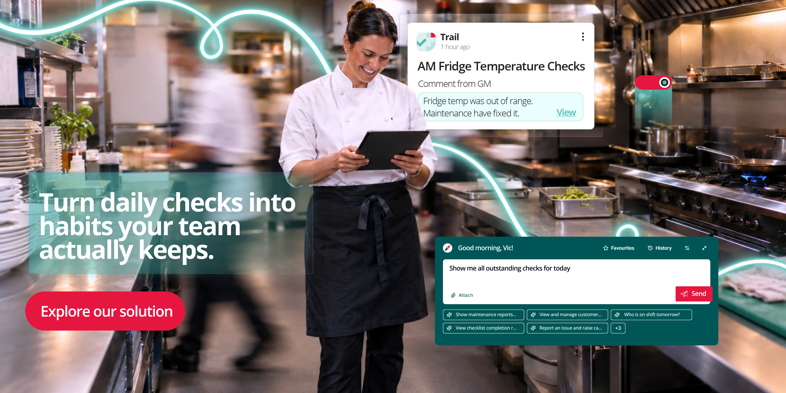
Make the changes today to keep your staff tomorrow
What are the 5 Cs of hospitality?
The 5 Cs of hospitality are Competence, Character, Commitment, Communication, and Collaboration. Combined these five elements form a framework used to deliver exceptional guest experiences.
What are the 7 pillars of hospitality?
The 7 pillars of hospitality are: Self-awareness, knowing your role, Guest awareness, knowing what your customer needs, Connection with your customer, Authenticity, being true to your business and brand, Anticipation, so you fulfil the needs of your customer before they arise, Alignment, bringing your whole team together to provide a unified experience, and Presence, remaining full engaged.
Do I legally need a food hygiene certificate?
No, a food hygiene certificate is not a direct legal requirement in the UK, but businesses are legally required to ensure that all food handlers are adequately trained for their roles. So, food hygiene training is mandatory, and having a food safety management system in place is a legal requirement.
What makes a good shift manager?
To be a good shift manager, you must stay calm under pressure, communicate clear expectations, and lead by example while supporting your team. Using technology to support daily admin tasks will help free up time and make the role less stressful.